Monday, 4 August 2014

The Art of Ley Kenyon

Today we're looking at the work of diver and artist Ley Kenyon.

A war hero, Bennett Ley Kenyon was one of the prisoners in the infamous Stalag Luft III and was part of the events dramatised in The Great Escape. His artistic skills saw him working as one of the camp forgers producing fake documents. In the absence of any cameras, he also produced six drawings that documented the tunnels. One source claims that the work damaged his eyesight and he wasn't allowed to be one of the escapees, while another says that it was simply that the tunnel was discovered before he could escape. I haven't been able to confirm which is correct but whatever did prevent him escaping almost certainly saved his life.


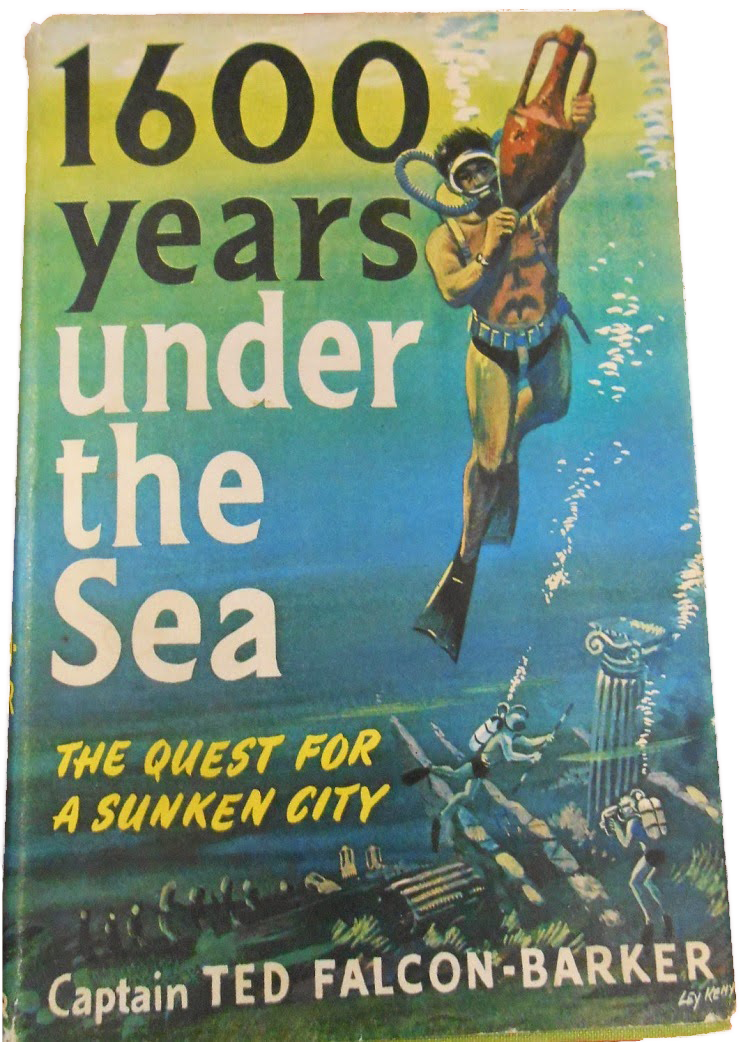
After the war, in addition to being an artist and author, Kenyon was himself a diver who worked with Cousteau in the 1950s. He wrote and illustrated a number of books including Aqualung Diving (with Werner de Haas, 1956), Collins' Pocket Guide to the Undersea World (1956) and Discovering the Undersea World (1961). His work also graced the covers of other authors' books, including diving pioneer Hans Hass. The cover of Pierre de Latill and Jean Rivoire's Man and the Underwater World features artwork by Kenyon and he is also the diver pictured.


In 1956, the News of the World launched a new comic for boys called Rocket, the Space-Age Weekly. The editorial gave a brief introduction to Kenyon who wrote and drew the adventures of Professor Jack Ransom in full colour on the back page.


The Seabed Citadel introduced us to the professor and his rather impractical looking diving suit. Like many comic-strip adults, he had no hesitation involving children in his adventures, in this case his nephews Tom and Jeff.


Exploring various wrecks, the intrepid trio have a nasty encounter with some Japanese Crabs


before following a strange glow which leads them to - can you guess? - yes that's right, a seabed citadel. In one panel Jeff imparts a little snippet of information about Scorpion Fish


but Kenyon soon abandons any pretence of scientific accuracy when they are attacked by "man-eating" Mantas (or Mantuas as he calls them).


Issue 25 saw the start of a new adventure with rather more practical diving gear but Rocket was cancelled a few weeks later with number 32 being the final issue. The story was cut short and a panel of text told the reader what would have happened.


Ley Kenyon passed away in 1991.

Sunday, 3 August 2014

Roll Six for the Art of Diving.

Here's something to keep the divers out there amused during their surface intervals. This game appeared in The Victor Summer Special 1970. Click on the single pages for larger versions. Don't get so caught up in the game that you forget to go diving though!


On the subject of games, this one was based was on the short-lived TV series The Aquanauts. Broadcast during the 1960-61 season, the series starred Keith Larsen and Jeremy Slate as two Californian salvage divers. Ill-health caused Larsen to quit after 14 episodes and he was replaced by future Tarzan star Ron Ely. After a few more episodes the diving was dropped and the series was renamed Malibu Run. The show was unable to compete with the popular western series Wagon Train and didn't survive beyond its single season of 32 episodes.


Finally, here's the box of the 1982 game, Lost Treasure.


Sunday, 27 July 2014

The Archie of Diving

The second of today's entries features a selection of Archie Comics covers and pin-ups, most of which are new to this version of The Art of Diving.

We start with a quartet of images by Dan DeCarlo.

1961


1970


Both of the above feature the hose coming directly from the cylinder, a Dan DeCarlo trait which I've mentioned before.

1969


1971 (Take a look at Betty's socks-cum-fins!)


Update - 4/2/15

 Subby over on the Aquafans forum has posted a selection of pictures from a 1970 issue of Time. The following picture looks like it must have been the inspiration for Betty's outfit above.


Born in 1919 in New York, Dan DeCarlo was drafted in 1941 and was stationed in the UK. He worked as a draughtsman and also painted mascots on military planes. While in Belgium he met his future wife, Josie Dumont, a French citizen.

In 1947, back in the USA and labouring for his father, he answered an ad and began working for editor Stan Lee at Timely Comics (later Atlas and Marvel). Initially working on the teen humour title Jeannie, he made his mark with a ten year run on Millie the Model. DeCarlo and Lee also produced over forty issues of My Friend Irma, based on a popular radio and TV comedy. He also drew cartoons for Timely/Atlas publisher Martin Goodman's line of Humorama pin-up magazines.

In the late fifties he started freelancing for Archie Comics and eventually set a new, more modern house style for the characters. A prolific cover and pin-up artist, he's probably most associated with his work on Betty and Veronica but also created Sabrina the Teenage Witch and Josie, named after his wife. First published in 1963, Josie (originally She's Josie) was renamed Josie and the Pussycats in late '69 to tie in with Hanna-Barbera's Saturday morning cartoon series.

DeCarlo's twin sons, Dan Jr and James, both worked as artists for Archie but both sadly predeceased their father in 1990 and 1991. In 2001 he lost a lawsuit over ownership of Josie during production of the Josie and the Pussycats live-action movie and this ended his 43-year relationship with Archie Comics. Some of his final work was for Bongo Comics' Bart Simpson. He died of pneumonia in December 2001 aged 82.


The cover of Jughead #99 is from 1963 and you can see an interior page, also by artist Samm Schwartz, in my earlier entry The Artt of Diving.


I'm afraid I don't know the artist on these final two covers although the Joke Book one is possibly Bob White.

1963


1973


The Holy Art of Diving

The first of today's entries consists of just one image but it's a corker! Another of Walter Molino's paintings for La Domenica Del Corriere, it features the Christ of the Abyss (Il Cristo degli Abissi) situated in the bay of San Fruttuoso, near Portofino in Italy. Designed by Guido Galletti, it was placed in the water on the 22nd of August 1954 near the spot where Italian diving pioneer Dario Gonzatti died in 1947. I did my instructor course in the area in 2004 but sadly was unable to dive the statue as it had been removed from the water for restoration at the time.

The painting shows the fourth anniversary of the statue being marked by a mixture of professional and amateur divers making "an unusual pilgrimage". They placed wreaths and torches "after hearing mass celebrated aboard a great ship".


Monday, 21 July 2014

The Art of Diving to the Rescue!

Having spent the weekend helping teach a Rescue Diver course I was inspired to put together this collection of images.

This first piece appeared in the weekly Italian magazine La Domenica del Corriere in July 1959. Published from 1899 until 1989, it was renowned for it's colour front and back covers which remain collectable to this day. One of the regular artists was Walter Molino and you can read a little more about him here.


The illustration is for a story about a diving accident involving Vittorio Emanuele Alberto Carlo Teodoro Umberto Bonifacio Amedeo Damiano Bernardino Gennaro Maria di Savoia (Vittorio Emanuele di Savoia for short). Known as the Prince of Naples and the Duke of Savoy, he is the only son of Umberto II, the last King of Italy, and has spent most of his life in exile. The text tells us that, during a visit to San Diego, he met with Jacques Piccard who had the bathyscape Trieste. During a dive to 25 metres he ran out of air and made a rapid ascent. The sudden pressure change caused "a sudden illness" but, following a visit to a recompression chamber, Vittorio Emanuele "was quickly restored."


New Heroic Comics number 91 was published in 1954 by Eastern Color under the Famous Funnies banner. Unfortunately the artist is unknown.


No rescue-themed entry would be complete without those brave boys from International Rescue. In issue 172 of TV Century 21, dated May 4th 2068 (a feature of the comic was that it was dated a hundred years in the future), we see Gordon and Brains having to rescue a trapped diver and disarm a rogue neutron cannon. All in a day's work for the Thunderbirds boys! (Scans courtesy of Lew Stringer's wonderful Blimey! It's Another Blog About Comics! )


Artist Frank Bellamy is a British comics legend. After a start in advertising he began working in comic strips. His body of work includes Monty Carstairs (Mickey Mouse Weekly), Robin Hood, King Arthur and Swiss Family Robinson (Swift) and The Ghost World (Boys' World). Some of his most famous work was for Eagle: Dan Dare, Fraser of Africa, Heros the Spartan, The Happy Warrior (Winston Churchill), Montgomery of Alamein and The Shepherd King (David). He drew Thunderbirds from 1966 - 69 and also did editorial work for the likes of Radio Times and The Sunday Times Magazine. In 1971 he took over the art duties on the Daily Mirror's Garth which he drew until his death in 1976 aged 59.


This American Manhood cover dates from 1952. In addition to his painted covers, artist Peter Poulton was known for his pen-and-ink illustrations for science fiction magazines.


Finally, we have two covers, from Sweden and Norway respectively, illustrating the Modesty Blaise story The Bluebeard Affair. They both depict Modesty's dramatic rescue of Willie Garvin. I don't know who was responsible for the Norwegian cover but Ake Forsmark and Ola Forssblad of the Modesty Blaise Facebook Group have both suggested Thord Lindblom as the Agent X9 artist.


You can see the full rescue in my recent blog entry here.


Monday, 14 July 2014

Ever Since I Was a Young Buoy...

Here's something a bit different, some scuba-themed pinball machines. Being a Pinball Wizard could be handy for a diver; those "crazy flipper fingers" might prove very useful...

This 1970 machine from Gottlieb paints a rather unrealistic view of diving. A wreck, a shark, treasure and a mermaid all in one dive?! That hardly ever happens.


This 1971 Bally table paints a more futuristic view of diving but I'm not sure how easy it would be to equalise with a glass bowl on your head.


The other machines allow for one or two players but this Stern table from 1977 can have four players. Remember though, always play pinball with a buddy!


Friday, 11 July 2014

Wrecks Special

Sorry, that should be "Rex" Special!

Artist Gil Kane (real name Eli Katz, 1926-2000) had a career that spanned six decades. He worked on the revamped Green Lantern and Atom for DC in the 50s and 60s and later drew Spider-Man for Marvel. During the 70s he was Marvel's primary cover artist. However, I'm confident that he considered his seven year run on Rex the Wonder Dog to be the pinnacle of his career!


Rex, a former military dog, was owned by Major Dennis and his son Danny. In issue 27 (1956) he was faced with the Mystery of the Midget Sub! And no, your eyes aren't deceiving you, that really is scuba gear that Rex is using!


Following a nuclear test, Major Dennis is checking the sea bed for signs of radiation. As you do. Danny and Rex become concerned when he doesn't surface as scheduled...


Danny and Rex follow a trail of pearls when suddenly the shadow of a giant ray falls across them...


Continuing to follow the pearls, our intrepid pair find a sunken ship. As they watch, a midget submarine leaves the wreck and proceeds to destroy it with a torpedo...


Following the sub to the surface, Danny and Rex rescue Major Dennis from thieves who had sunk the ship so that they could retrieve the cargo of pearls later.

Two years later, in issue 42, Rex was involved in more aquatic adventures...


 This time he eschews the use of scuba gear to show off his extraordinary breath-holding abilities.


Danny is told that Bluebeard's treasure is somewhere nearby but he's more interested in finding specimens for his town's aquarium...


I'd love to know what Nora's tanks are made of that they can be "ripped" by coral!

Nora agrees to help Danny and they go diving the following day, but Rex is worried because he senses a storm coming. During one of their dives Rex spots trouble and gets to repeat his shark fighting trick...


No sooner has Rex dealt with the octopus than the storm causes the cave to collapse, sealing the treasure inside. Fear not though because Danny and Nora escape thanks to Rex, the Wonder Dog!